Core content
- Primary narrative
- Concise answer blocks
- Comparisons and tables
- Contextual next action
Lumenario combines content governance automation, a governed content governance system, source verification, and claims approval in one reviewable workflow. Validated buyer opportunities become complete Knowledge Nodes—content, FAQs, visuals, metadata, links, and sources—before human review and approval.
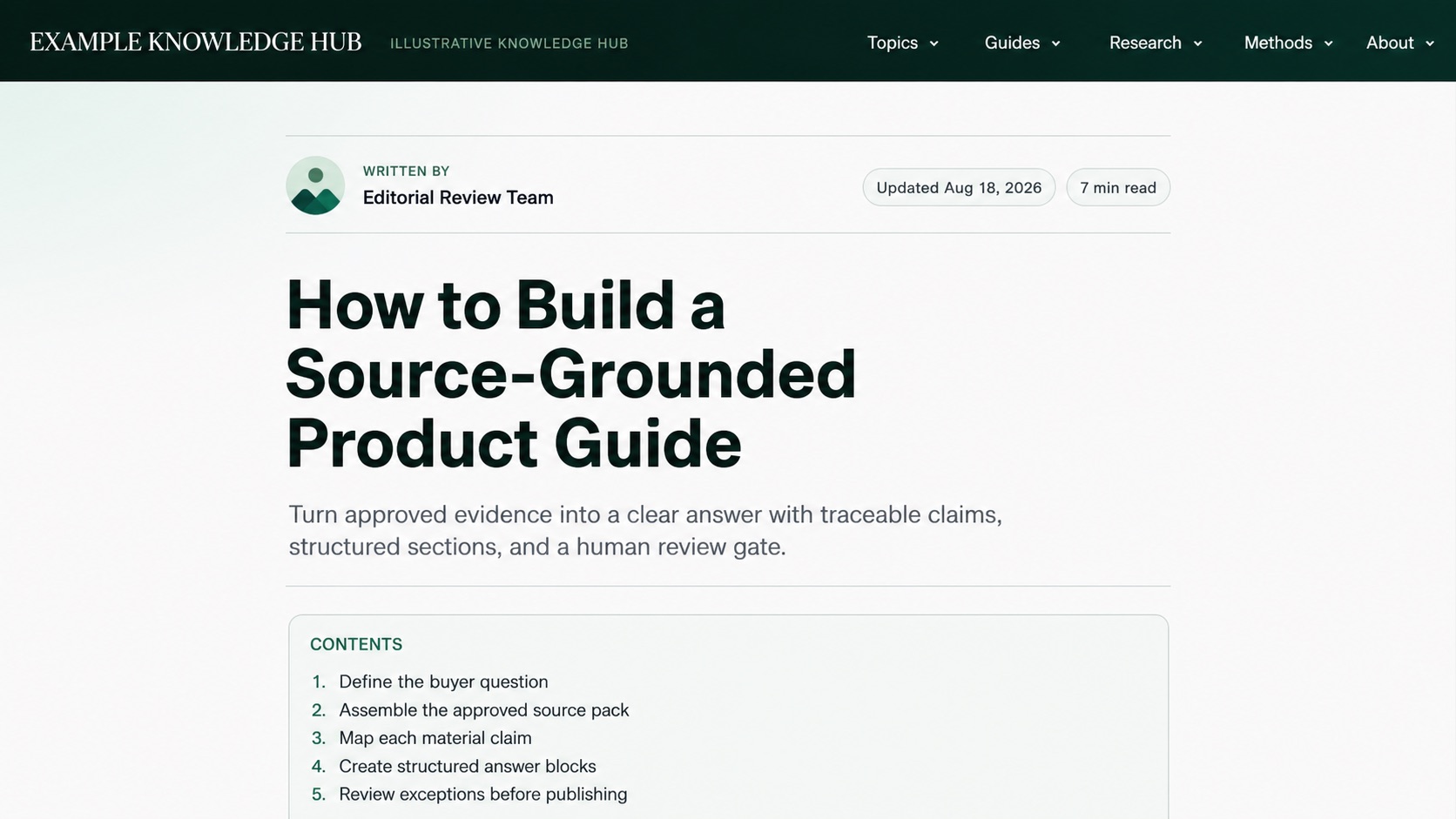
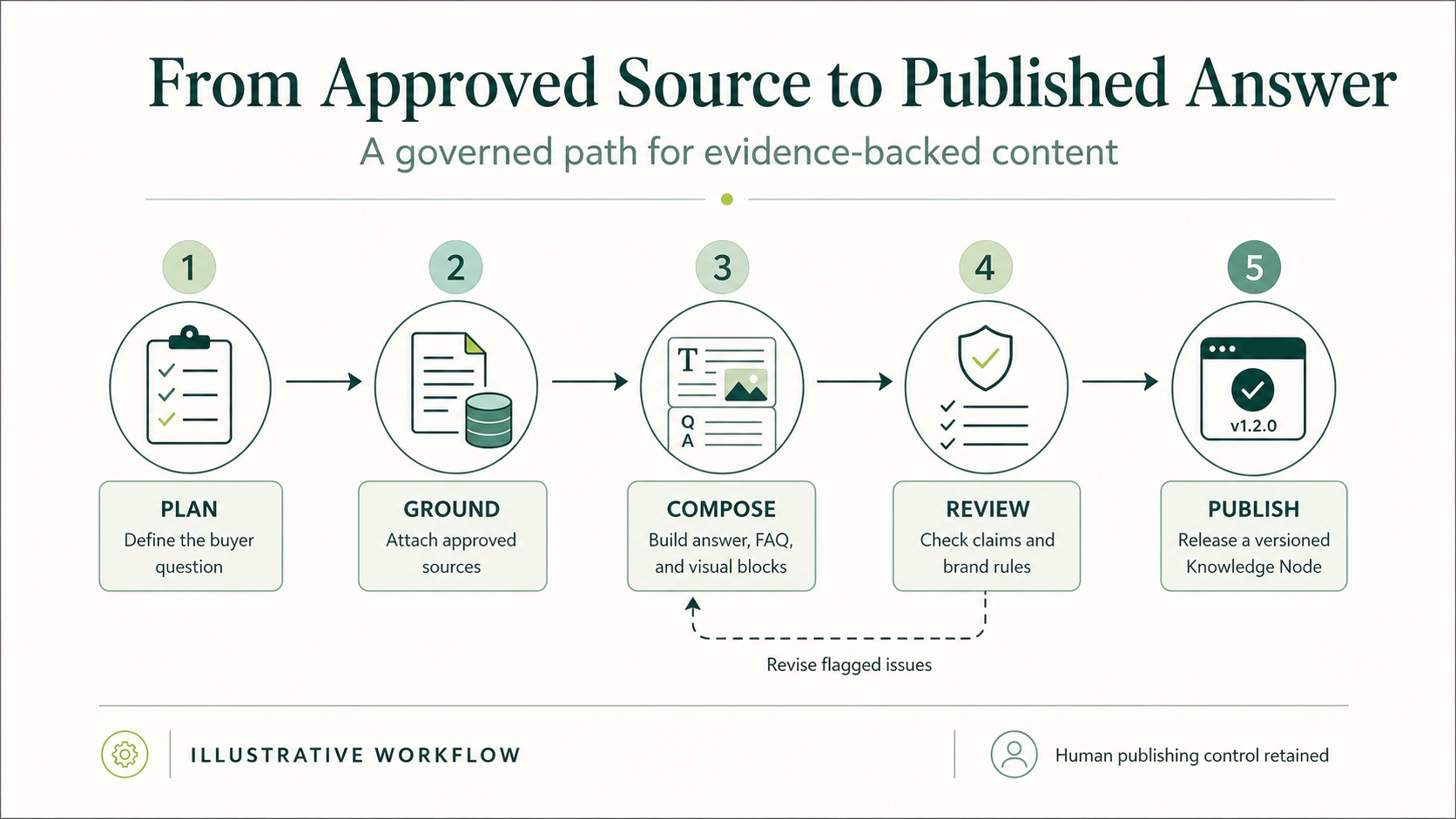
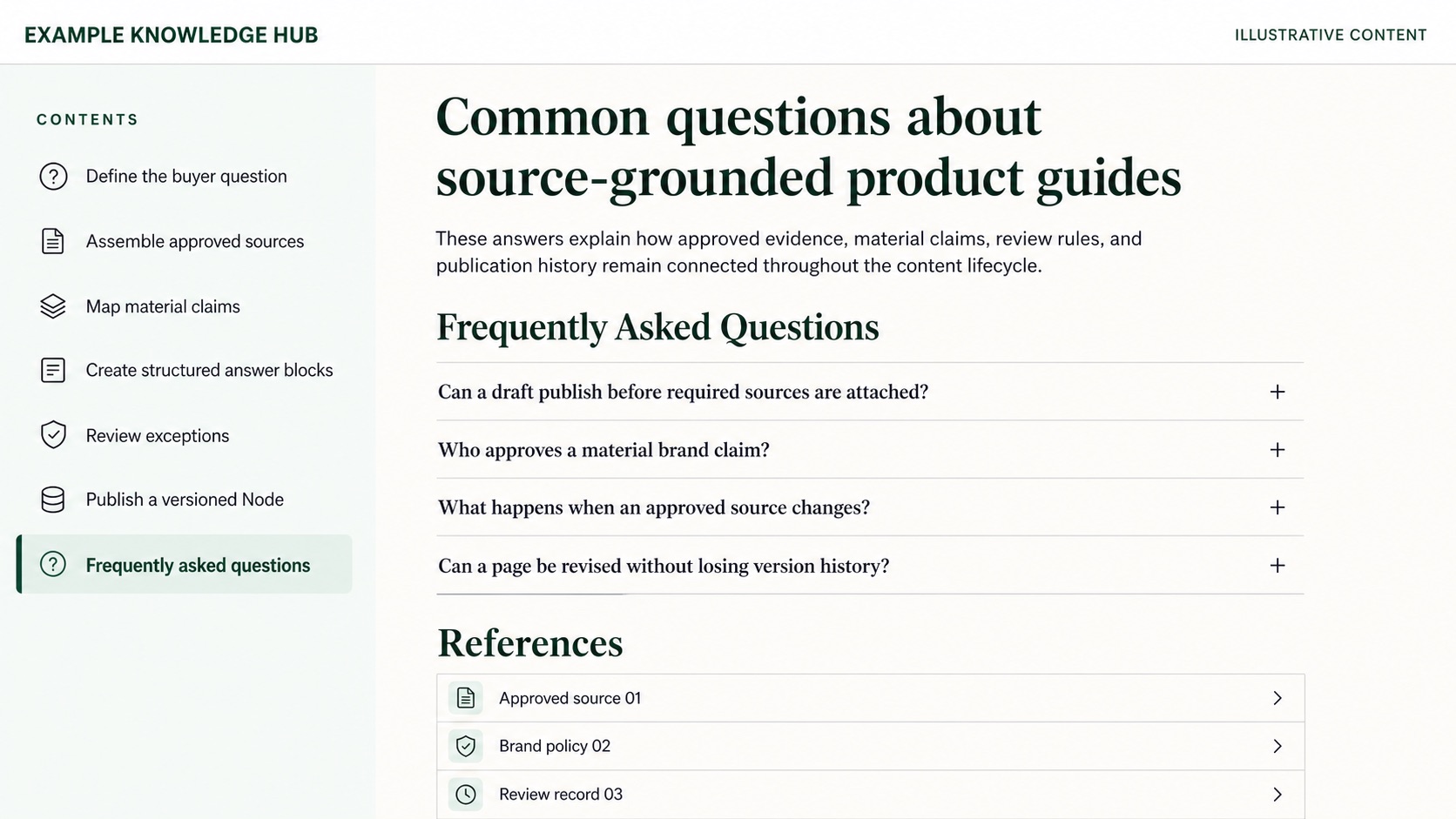
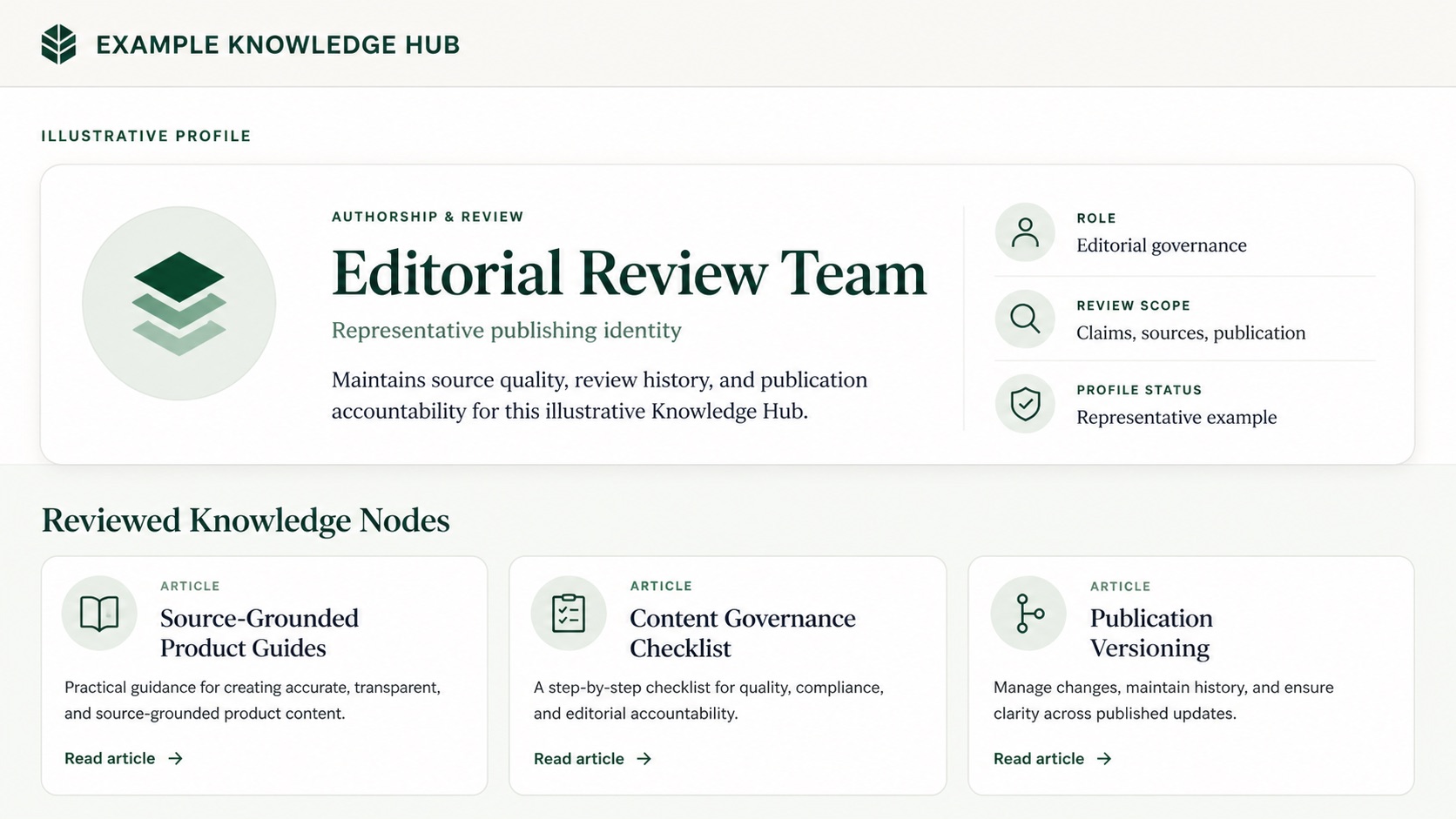
A Safe Node groups every format needed to answer one validated buyer need. The content, evidence, visual explanation, and publishing fields remain connected through review.
The human-readable output is visible in the hero carousel. Underneath it, the publishing layer emits structured data and a public AI-readable manifest from the same approved publication record.
{
  "@context": "https://schema.org",
  "@type": "Article",
  "headline": "How to Build a Source-Grounded Product Guide",
  "mainEntityOfPage": "https://knowledge.example.com/source-grounded-product-guide/",
  "publisher": {
    "@type": "Organization",
    "name": "Example Knowledge Hub"
  },
  "author": {
    "@type": "Organization",
    "name": "Editorial Review Team",
    "url": "https://knowledge.example.com/editorial-review/"
  }
}
The current public detail renderer generates Article JSON-LD with author and publisher metadata. FAQ content is visible on the page; it is not currently emitted as separate FAQPage JSON-LD.
# Example Knowledge Hub

Public articles for knowledge.example.com.

- [How to Build a Source-Grounded Product Guide]
  (https://knowledge.example.com/source-grounded-product-guide/):
  Turn approved evidence into a clear answer with traceable
  claims, structured sections, and a human review gate.

- [A Beginner's Guide to Content Governance]
  (https://knowledge.example.com/content-governance/):
  A practical introduction to governed editorial delivery.
The manifest is served from the public tenant hostname and lists published pages with their metadata descriptions. Preview sessions do not expose this root-level file.
Safe Node Generation receives the validated buyer question, mapped intent, answer gap, brand context, and right-to-win rationale. Separate editorial functions then plan, ground, create, challenge, and prepare the Knowledge Node for human approval.
Defines the audience, answer objective, scope, formats, evidence requirements, restrictions, and review owners.
Assembles approved sources, records provenance and permissions, and flags evidence gaps before drafting begins.
Drafts the core answer, supporting sections, and FAQs while carrying citations and required qualifiers forward.
Shapes answer blocks, tables, metadata, links, images, infographics, captions, alt text, and accessible layout.
Checks intent coverage, claims, sources, qualifiers, visual data, brand rules, metadata, and accessibility.
Brand, subject-matter, legal, or compliance reviewers approve, request revision, or block publication.
The verification ledger makes the decision visible. Supported material can move forward; weak, incomplete, or restricted output is qualified, revised, escalated, or blocked.
Swipe to review every check and decision →
| Claim or asset | Evidence | Check | Decision |
|---|---|---|---|
| Product efficacy statement | Product study · p.18 | Supported | Keep with citation |
| Eligibility FAQ answer | Policy v4.2 | Needs qualifier | Revise answer |
| Infographic statistic | No approved source | Blocked | Remove figure |
| Product-in-use image | Brand library + usage rules | Human review | Confirm context |
Google says appropriate use of generative AI is not against its guidelines. The risk is publishing unoriginal, misleading, or low-value pages at scale primarily to manipulate search rankings.
No platform can guarantee rankings, citations, or immunity from future algorithm changes. Safe Node Generation provides a more defensible creation and review process.
Automation removes repetitive assembly and review work without removing accountability from brand, product, legal, or compliance teams.
Turn validated market demand into complete, source-grounded Knowledge Nodes while keeping evidence, corrections, approval, and publishing control connected.
Human approval remains part of the publishing workflow.