“Which companies lead this category, and why?”
AI SEARCH OPPORTUNITY MAPPING
Know what buyers are asking—and where your brand can win first.
Lumenario finds what buyers ask, identifies gaps in your coverage, and ranks the opportunities your brand can credibly address. Approve an opportunity and its agents research, write, and verify the page, then publish it after your sign-off.
Brand + search demandContextual intent clustersExplainable production decision
WHAT BUYERS ARE ASKING
Different questions can reveal the same buying decision.
A buyer can express one need through a direct question, a comparison, a problem statement, or a long-tail search. AI Search Opportunity Mapping brings these signals together so your team sees the intent—not a disconnected list of phrases.
THE MAPPING DISTINCTIONContextual intent mapping
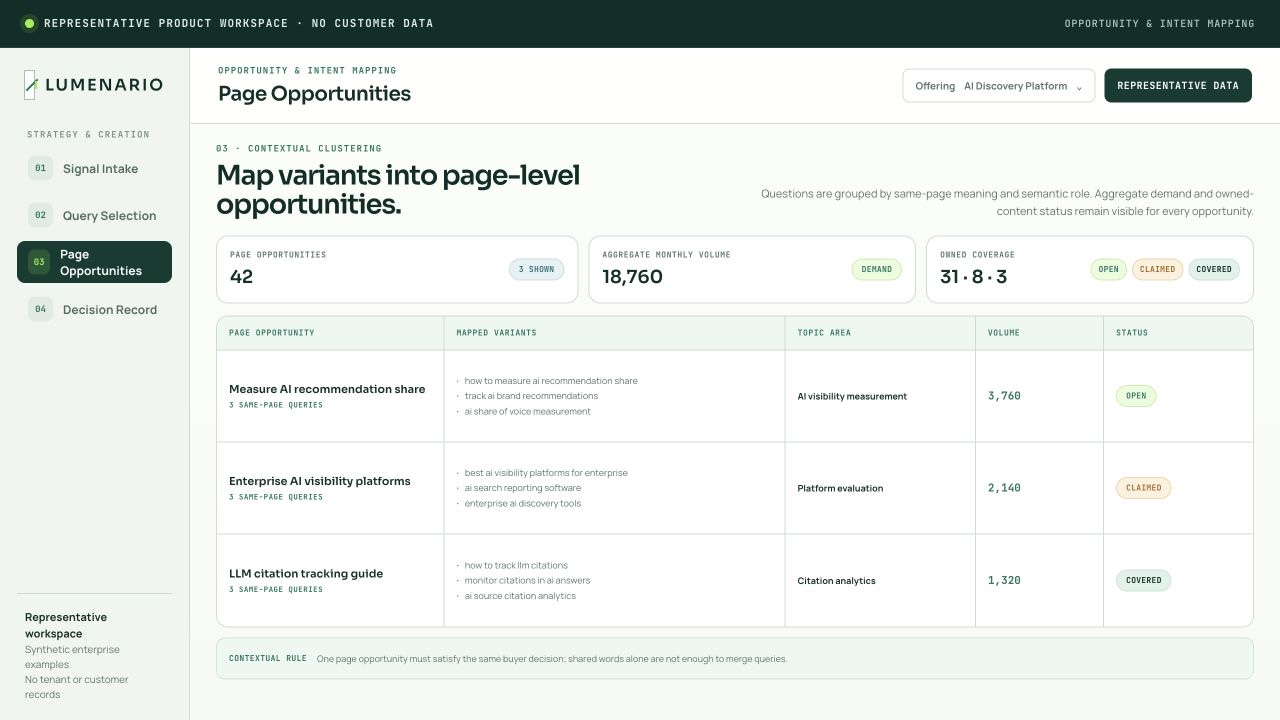
Questions are grouped by meaning, buyer stage, and the decision being made—not merely by words that happen to look similar.
QUESTION CLUSTERMeasure competitive AI visibility
4 signals · 1 intent
CORE INTENTUnderstand whether the brand is being discovered and recommended more or less often than competitors.
“How do I track visibility across AI-generated answers?”
“Why is a competitor cited when our brand is not?”
“How can I prove our AI-discovery investment is working?”
WHERE CAN YOUR BRAND WIN FIRST?
A high-volume question is not automatically a strong opportunity.
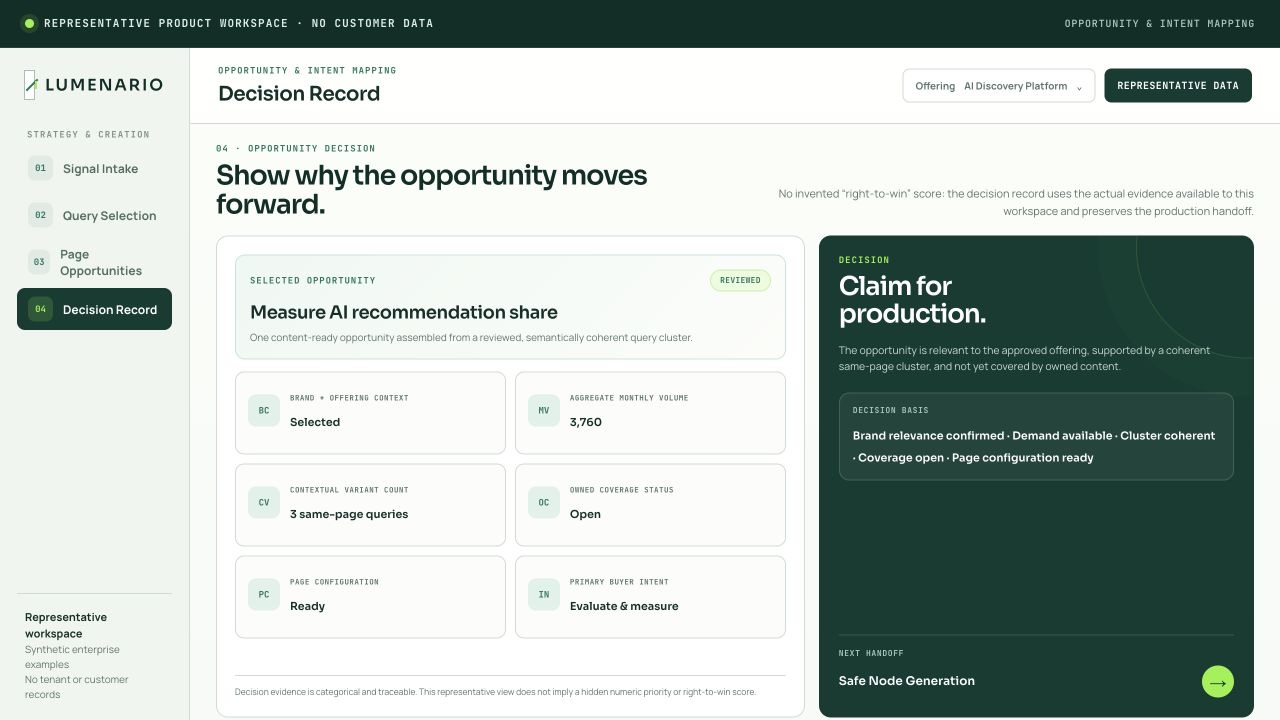
Each intent cluster moves through an explainable decision framework: buyer demand, the answer gap, brand relevance, evidence readiness, and competitive effort. The final production decision retains the signals available for that opportunity instead of hiding them inside a black-box score.
Buyer demand
Is the question appearing often enough, across enough signals, to matter?
Answer gap
Are existing AI and search answers absent, incomplete, or shaped by others?
Brand relevance
Does the intent connect to an offering, audience, claim, or category priority?
Evidence readiness
Can the brand support a useful answer with approved knowledge and sources?
Competitive effort
How much credible coverage already exists, and what would it take to compete?
WHAT HAPPENS NEXT
Approve an opportunity. Lumenario takes it through to publication.
Every opportunity you approve becomes a brief, then researched and verified content ready for your sign-off. Lumenario publishes the approved page without a hand-off between research, writing, and delivery teams.
Buyer Question Map
See the language buyers use.
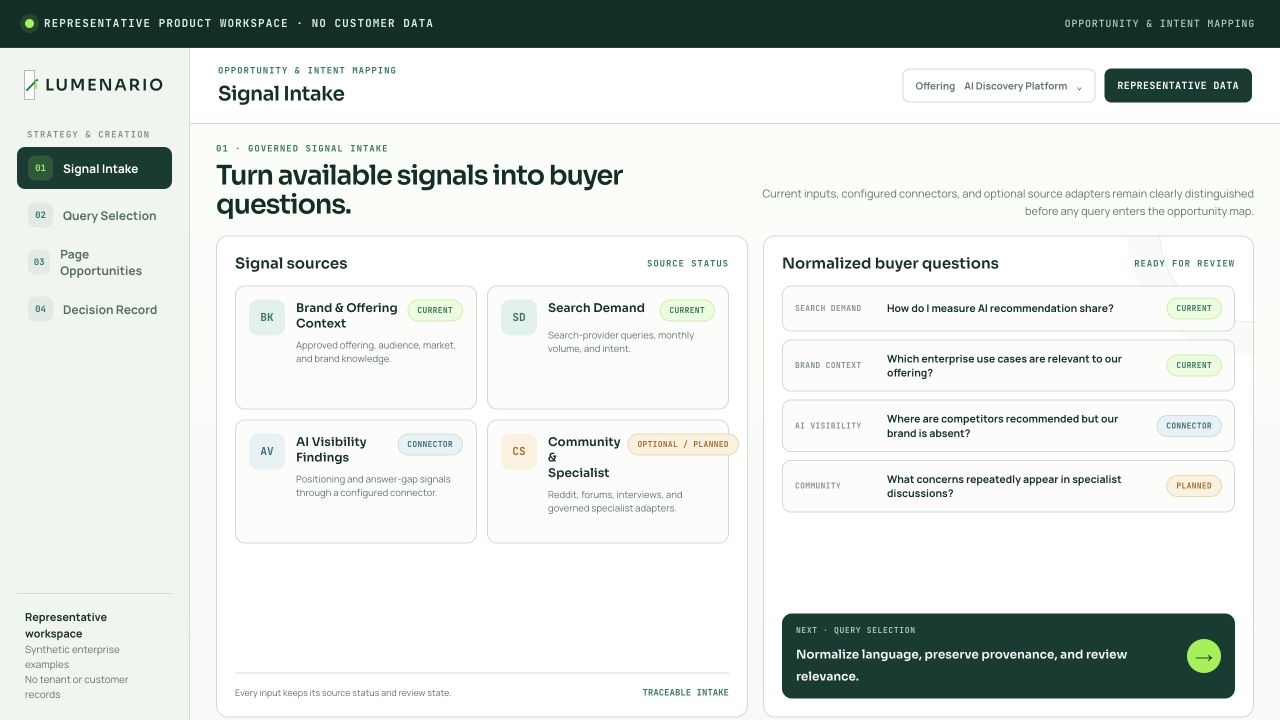
Bring questions, comparisons, objections, problems, and use cases from AI and search signals into one structured view.
Contextual Intent Clusters
Understand the decision behind each phrase.
Connect differently worded questions that serve the same informational, evaluation, comparison, or purchase intent.
Answer-Gap Analysis
See where others are answering without you.
Identify where answers are missing, incomplete, weakly evidenced, or dominated by competitors and third-party sources.
Ranked Opportunity Roadmap
Know what deserves investment first.
Sequence opportunities using demand, answer gaps, brand relevance, evidence readiness, and competitive effort.
WORKED EXAMPLE · HOW THE MAP IS BUILT
From one priority category to an explainable decision map.
Start with a product, service, buyer problem, use case, or category your brand wants to own. The system expands the surrounding demand, maps the intent, and ranks the opportunities before production begins.
Understand brand context
Connect the category to offerings, audiences, market priorities, existing pages, and approved Brand Knowledge.
Expand demand signals
Collect related questions, comparisons, objections, use cases, searches, and category language.
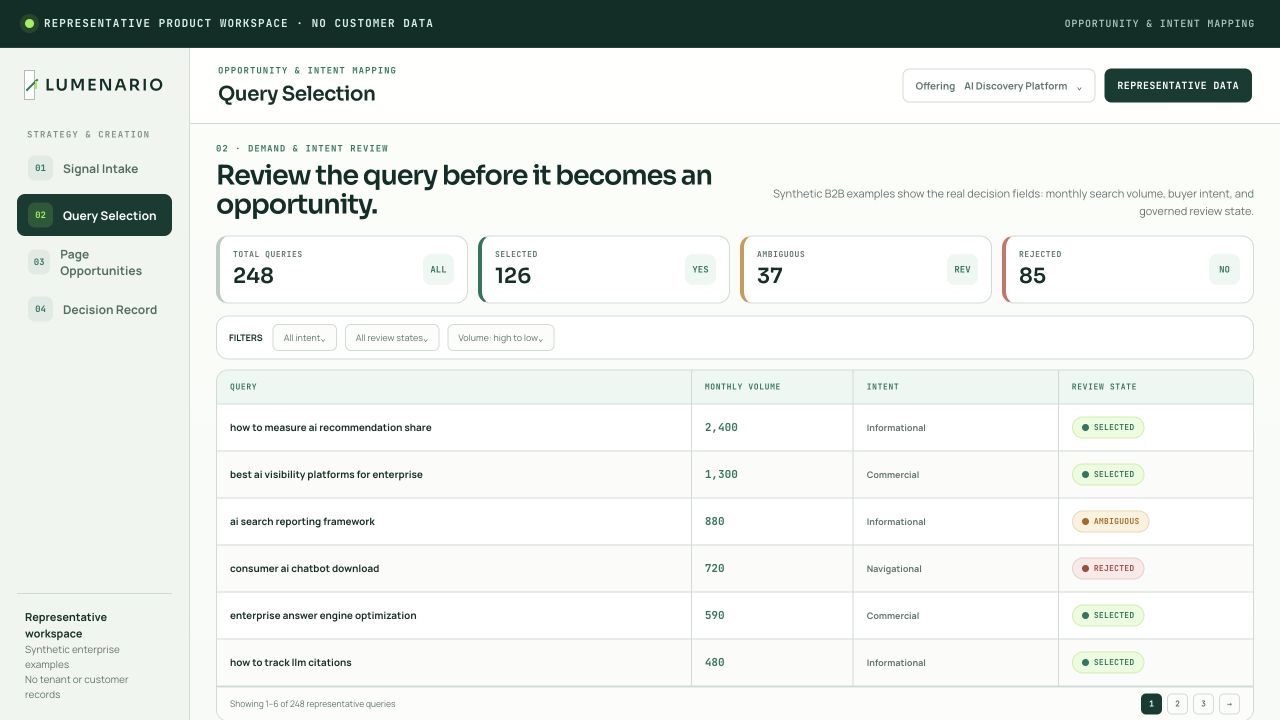
Validate buyer questions
Remove irrelevant, duplicative, off-positioning, or low-value demand before mapping.
Map questions by intent
Organize demand around the decision a buyer is making—not merely similar wording.
Rank and brief the opportunity
Recommend what to pursue, then package the selected question, intent, right-to-win rationale, and evidence needs into an editorial brief.
NEXT · SAFE NODE GENERATIONThe ranked opportunity becomes a governed editorial brief.
See the editorial process →
Safe Node Generation plans, grounds, writes, composes, challenges, and routes the response for human approval.
START WITH ONE PRIORITY CATEGORY
Find the next discovery space your brand can credibly own.
Choose one product, service, or category priority. Lumenario will map the buyer questions, reveal the unanswered intent, and show where your brand has the clearest opportunity to win first.
Start with an opportunity map—not another open-ended content calendar.