Google AI Overview Not Working? Every Error and Fix
Can't generate an AI Overview? No reply box? AI Mode not responding? What each Google AI error means and how to fix it on Chrome, Safari, Android and…
Practical frameworks to help businesses navigate Answer Engine Optimization and sustainable organic expansion.
Can't generate an AI Overview? No reply box? AI Mode not responding? What each Google AI error means and how to fix it on Chrome, Safari, Android and…
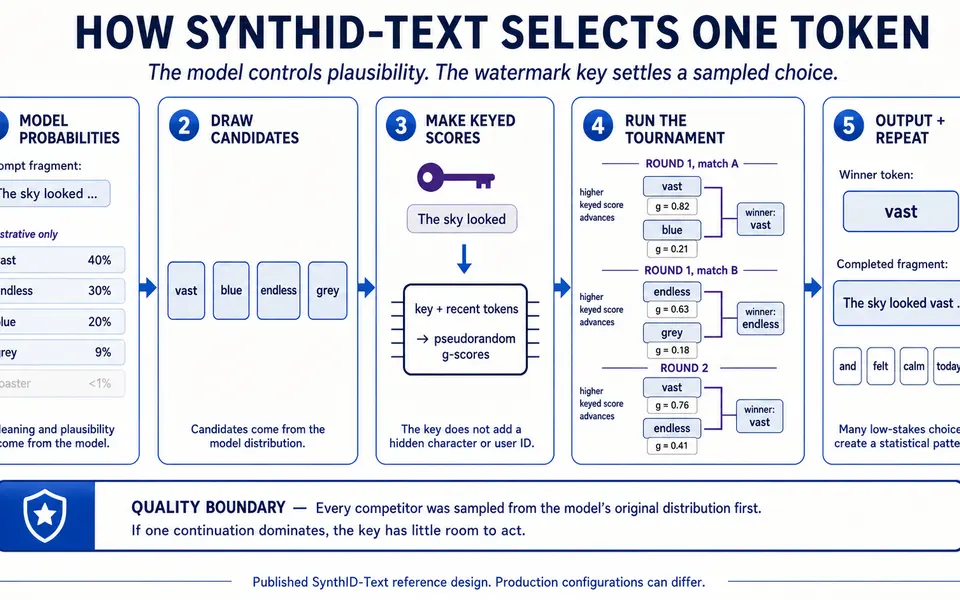
Learn how Google SynthID embeds and detects invisible watermarks in AI-generated text, images, audio and video—and what a result can actually prove.
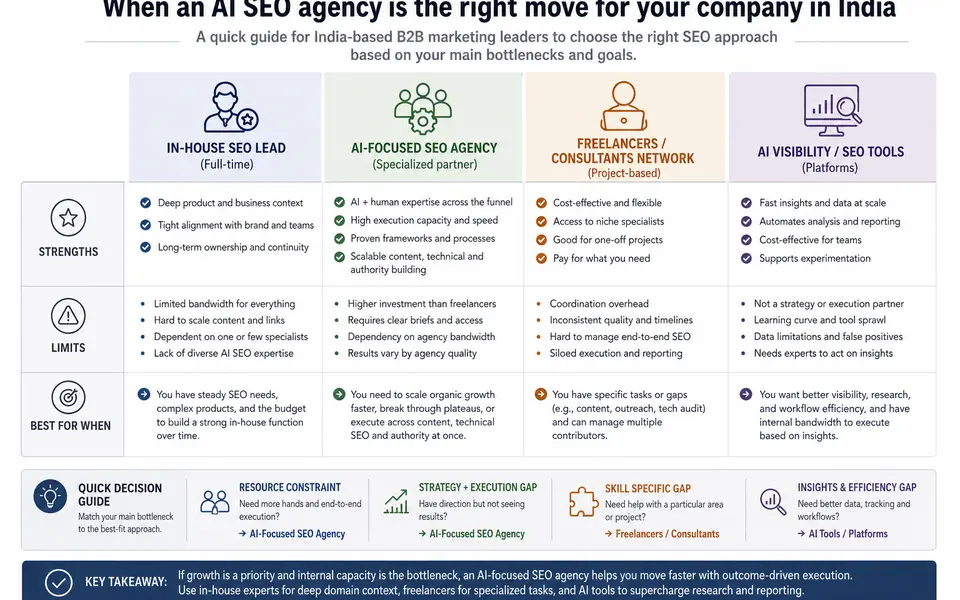
Compare AI SEO, AEO and LLM SEO agencies in India: locations, AI search services, public proof points and published pricing, plus how to choose and r…
Can you disable Google AI Overviews in India? Learn what Google allows, what settings help, and practical workarounds for users and SEO teams.
How do you show up in Google AI Overviews? Google says there's no special trick: your page must be indexed and eligible to show a snippet in Google Search. From there, pages that answer the question clearly and cover the related follow-up questions are the ones most likely to be picked as supporting links.
AI Overviews now reach 2.5B+ people a month (Google, I/O 2026).
What helps:
→ Make sure Google can crawl and index the page (check Search Console)
→ Answer the main question in the first 1–2 sentences
→ Cover the follow-up questions too. Google may run several related searches to build one AI Overview
→ Keep key content in text, not only in images or video
→ Don't block snippets: nosnippet and max-snippet limit what Google can show
Do you need special schema or an AI file? No. Google says no special structured data or AI text files are needed to appear in AI Overviews.
Lumenario helps brands get discovered, cited and recommended by AI answer engines like ChatGPT, Google AI Overviews, Perplexity and Gemini.
Website → https://www.lumenario.com/
Free AI visibility check → https://app.lumenario.com/ai-in-visibility-report
LinkedIn → https://www.linkedin.com/company/lumenario/
#AEO #AIOverviews #SEO
How does Perplexity pick which sites to cite? It searches the web live, then favors pages that answer the question directly, come from trusted sources, are recently updated, and include specific facts it can quote. If Perplexity's crawler can't reach your site, you can't be cited at all.
How to get cited more often:
→ Check that robots.txt isn't blocking PerplexityBot
→ Put the direct answer in the first lines of the page
→ Add specific data, examples and named experts
→ Keep key pages fresh and dated
→ Earn mentions on sites Perplexity already trusts
Does Perplexity only cite big websites? No. Smaller sites get cited when they give the clearest, most specific answer to the exact question.
SEO vs AEO vs GEO: what's the difference? SEO gets you ranked. AEO gets you chosen as the answer. GEO gets your brand mentioned and cited in AI-generated responses. Here's how all three work, where they overlap, and which one your brand should focus on first.
THE SHORT ANSWER
SEO (Search Engine Optimization): ranking your pages in search results like Google and Bing to earn clicks.
AEO (Answer Engine Optimization): structuring your content so search and AI systems use it as the direct answer, including featured snippets, voice assistants, AI Overviews and chatbots.
GEO (Generative Engine Optimization): increasing how often generative AI tools like ChatGPT, Gemini, Perplexity and Claude mention, cite and recommend your brand.
They overlap heavily, and many marketers use AEO and GEO interchangeably. SEO is the foundation; AEO and GEO build on top of it.
QUICK COMPARISON
Goal → SEO: rank and get clicks | AEO: be the answer | GEO: be mentioned and cited in AI responses
Where → SEO: Google and Bing results | AEO: snippets, voice, AI Overviews | GEO: ChatGPT, Gemini, Perplexity, Claude, AI Mode
Success metric → SEO: rankings and organic traffic | AEO: answers owned and citations | GEO: brand mentions, AI share of voice, AI referrals
WHAT YOU'LL LEARN
→ Clear definitions of SEO, AEO and GEO
→ How their goals, platforms and metrics differ
→ Where the three strategies overlap
→ Which one to prioritize for your business
→ How to build one strategy that covers all three
FREQUENTLY ASKED QUESTIONS
Is GEO the same as AEO?
They overlap almost entirely. AEO is the broader, older term covering any direct answer, including featured snippets and voice. GEO focuses specifically on generative AI models and the answers they write.
Where does the term GEO come from?
It was popularized by a 2023 research paper, "GEO: Generative Engine Optimization," by researchers at Princeton University and collaborators.
Do I still need SEO?
Yes. AI answer engines pull heavily from pages that are crawlable, indexed and authoritative. Weak SEO makes AEO and GEO much harder.
Which should I start with?
Get your SEO fundamentals solid, then layer on AEO and GEO: answer-first content, clear brand information, and mentions on the third-party sites AI tools rely on.
ABOUT LUMENARIO
Lumenario helps brands get discovered, cited and recommended by AI answer engines like ChatGPT, Google AI Overviews, Perplexity and Gemini.
Website → https://www.lumenario.com/
Free AI visibility check → https://app.lumenario.com/ai-in-visibility-report
LinkedIn → https://www.linkedin.com/company/lumenario/
Subscribe for weekly breakdowns on AEO, GEO and AI search
#SEO #AEO #GEO
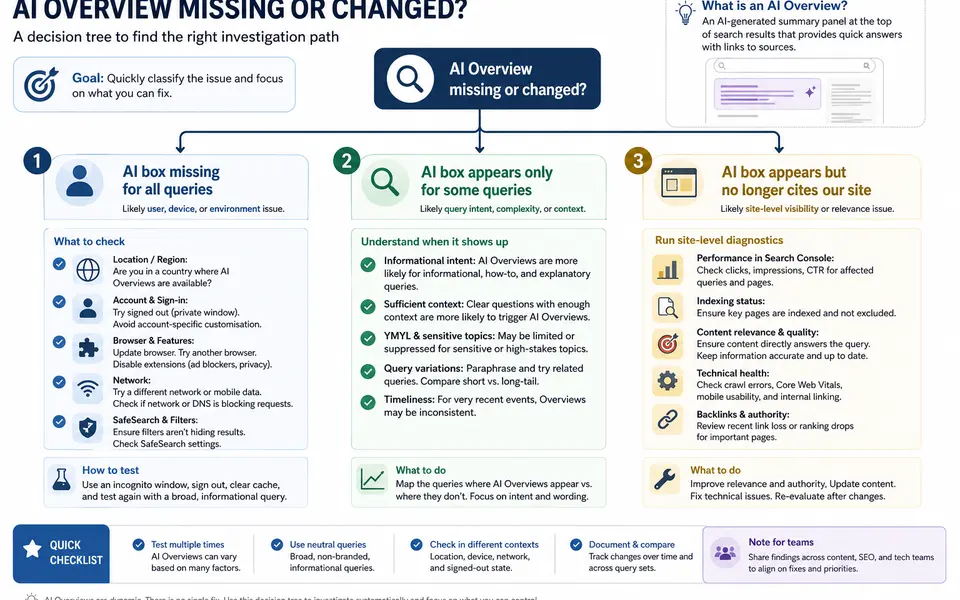
Google does not provide a universal on-and-off switch for the core AI Overview experience. Search Labs settings may affect experiments, but toggling an experiment does not guarantee an overview for a query. Use the default All results view and test account, browser and network conditions instead.
Read the full answerGoogle shows an AI Overview only when it decides a generated answer will help more than the regular results. Broad or multi-part questions are more likely to get one; short navigational searches, breaking news and some sensitive topics are less likely. The same query can also change from day to day.
Read the full answerCheck that you're on the All tab rather than Web, then try a private window. If overviews come back there, an extension or stored cookies are the cause. If they're missing everywhere, Google may have stopped showing one for that query, or there may be a temporary problem; try again later.
Read the full answerOur contributors
Behind the answers
contributor sharing their knowledge in this library.
Connected reading
Publication log
